
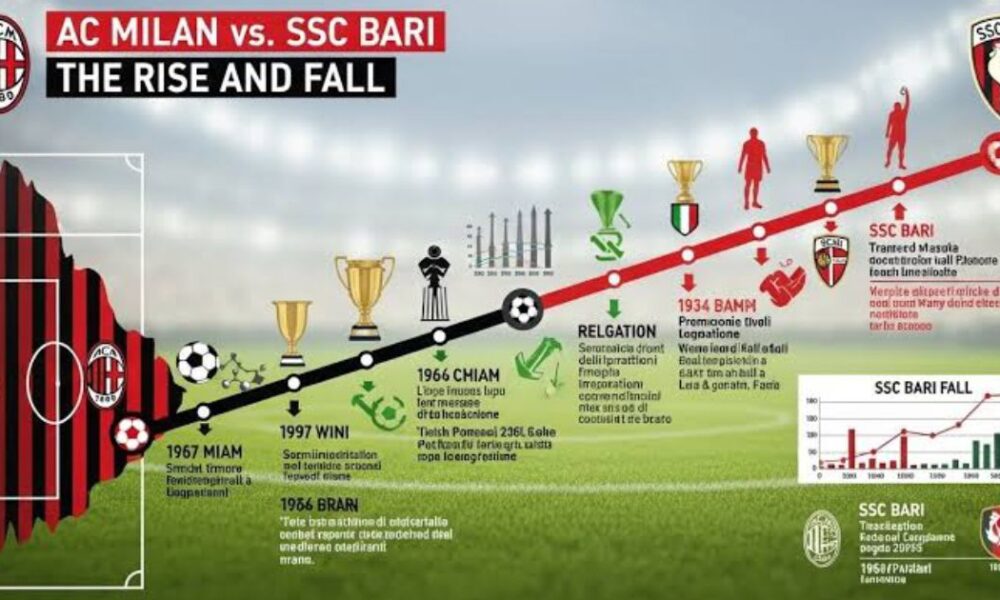
The fixture between AC Milan and SSC Bari serves as a fascinating lens through which to view the evolution of Italian football. While it may not carry the geopolitical weight of the Milan Derby or the historic intensity of the Derby d’Italia, the AC Milan vs. SSC Bari timeline is a story of two cities, two cultures, and two vastly different footballing philosophies.
On one side stands the Rossoneri, a global brand synonymous with European royalty and tactical innovation. On the other sits the Galletti (The Cockerels), representing the passionate, gritty, and often unpredictable football culture of Southern Italy. Whenever these two meet, the narrative is clear: the established aristocracy versus the defiant underdog.
I. Club Background: A Tale of Two Cities
AC Milan: The Architects of Excellence
Founded in 1899 by English lace-maker Herbert Kilpin, AC Milan vs. SSC Bari Timeline was destined for greatness from its inception. By the mid-20th century, Milan had established itself as a pioneer, becoming the first Italian club to win the European Cup in 1963.
The club’s identity is built on a foundation of “total football” principles and defensive mastery. Throughout the decades, the halls of Milanello have been walked by the greatest names in the sport—from the “Gre-No-Li” trio of the 1950s to the Dutch Triumvirate of the late 80s, and the Galactico-era stars of the 2000s. For Milan, every match against a club like Bari is a test of maintaining their standard of excellence.
SSC Bari: The Pride of Apulia
Founded in 1908, SSC Bari’s history is a rollercoaster of triumphs and tribulations. Based in the sun-drenched coastal city of Bari, the club has long been the flagship of the Apulia region. Unlike Milan, Bari’s journey has been defined by the “Yo-Yo” effect—frequently oscillating between Serie A and Serie B.
Despite the lack of a trophy room filled with Scudettos, Bari’s contribution to Italian football is immense. The club has functioned as one of the country’s premier talent factories, developing world-class players and providing a platform for tactical experimentation. For a Bari fan, a trip to the San Siro isn’t just a game; it is an invasion of the North, a chance to prove that the South can play with equal fire and flair.
II. The Historical Timeline: Decoding the Eras
1. The Formative Years (1930s – 1970s)
In the early days of the round-robin Serie A, the gap between the two clubs was stark. Milan was already a national powerhouse, while Bari was fighting to establish a permanent residence in the top flight.
During the 1930s and 40s, matches were often high-scoring affairs. Milan’s superior fitness and professional structure usually overwhelmed Bari’s local-heavy squads. However, it was during this era that the “Bari Spirit” was born—a refusal to be intimidated by the bright lights of Milan. By the 1960s, even when Milan was conquering Europe under Nereo Rocco, Bari managed to secure a handful of gritty draws, signaling that they could not be taken lightly.
2. The Golden Age of the 1980s and 1990s
The late 1980s saw the birth of Arrigo Sacchi’s “Immortal” Milan. This was perhaps the most difficult period in the timeline for Bari. Facing a backline of Baresi, Maldini, Costacurta, and Tassotti was a nightmare for any striker.
However, the 1990s brought a shift. Italian football was at its absolute zenith, and even “smaller” clubs like Bari boasted international stars.
- The 1990-1991 Season: Bari pulled off one of the greatest upsets in their history, defeating a Milan side that featured the likes of Marco van Basten and Ruud Gullit.
- The Coppa Italia Drama: In the late 90s, the two sides met in a two-legged cup tie that remains legendary. Bari’s tactical discipline forced Milan to play at 100% capacity just to survive. The matches were characterized by a clash of styles: Milan’s sophisticated zone-pressing versus Bari’s lightning-fast counter-attacks.
3. The 2000s: Ronaldinho, Kaká, and San Siro Masterclasses
The turn of the millennium saw Milan return to the top of the world under Carlo Ancelotti. The fixtures during this era were often exhibitions of pure skill.
- The 2008-2010 Revival: Bari enjoyed a brief but glorious return to Serie A under coach Giampiero Ventura. They played a brave, expansive 4-2-4 formation.
- The Ronaldinho Goal: One of the most replayed moments in this fixture’s history occurred in 2009. Ronaldinho, at the height of his showmanship, scored a breathtaking goal from an impossible angle at the San Siro, reminding the world why the Rossoneri were a level above.
4. The Modern Era (2011 – Present)
The last decade has seen fewer meetings due to Bari’s financial struggles and relegation to the lower tiers of Italian football. However, whenever they have met—usually in the Coppa Italia—the matches have been highly competitive. Milan, undergoing a long rebuilding phase before their 2022 Scudetto win, often found a resilient Bari side that refused to act like a lower-league opponent.
III. Legendary Figures: The Men Who Defined the Matchup
The Rossoneri Titans
- Paolo Maldini: No player embodies the Milan side of this fixture more than Maldini. His longevity meant he faced multiple generations of Bari strikers, consistently shutting them down with elegance.
- Kaká: The Brazilian’s pace and verticality were often the “X-factor” that broke Bari’s compact defensive blocks in the mid-2000s.
- Zlatan Ibrahimović: In the more recent encounters, Zlatan’s physicality provided a focal point that Bari’s defenders struggled to contain.
The Galletti Icons
- Antonio Cassano: The “Pibe de Bari” (The Kid from Bari). Cassano’s rise to stardom began in Bari, and his performances against the big clubs—including Milan—made him a national sensation before he eventually wore the Milan jersey himself later in his career.
- Igor Protti: A cult hero for Bari, Protti’s ability to find the net against elite opposition made him the primary threat that Milan’s legendary defenders always had to watch.
- Gianluca Zambrotta: Though he became a legend at Milan and Juventus, Zambrotta’s journey began at Bari, representing the high-quality talent the club consistently produced.
IV. Tactical Comparison: A Clash of Ideologies
| Feature | AC Milan | SSC Bari |
| Primary Formation | Historically 4-4-2 (Sacchi) / 4-3-2-1 (Ancelotti) | Traditionally 4-4-2 or 4-3-3 (Counter-attacking) |
| Philosophy | Dominance: High possession, creative freedom, and territorial control. | Resilience: Compact lines, high-speed transitions, and physical duels. |
| Key Strength | Midfield maestros (Pirlo, Seedorf, Gattuso) controlling the tempo. | Opportunistic strikers and wide players exploiting space behind fullbacks. |
V. The Cultural Divide: San Siro vs. San Nicola
The contrast between the two stadiums is a visual representation of the rivalry.
San Siro (Milan): Known as the “La Scala del Calcio,” it is a cathedral of football. The atmosphere is one of expectation. The fans demand victory and style. When Bari visits, the “Curva Sud” creates a wall of red and black, meant to intimidate the visitors into submission.
Stadio San Nicola (Bari): Designed by the world-renowned Renzo Piano for the 1990 World Cup, it is nicknamed “The Spaceship.” The atmosphere here is raw and provincial in the best way possible. When a giant like Milan arrives, the entire city of Bari shuts down. The fans create a hostile, high-pressure environment that has caused many Milan stars to lose their composure over the years.
VI. Statistical Overview and Head-to-Head
Historically, AC Milan holds a significant advantage in total wins. However, the statistics hide a more nuanced truth: Bari has been one of the most successful “smaller” clubs at forcing draws against Milan.
- Average Goals: Matches between these two average roughly 2.8 goals per game, making it a generally entertaining fixture for neutral fans.
- Clean Sheets: Milan’s historical defensive strength has resulted in a high number of shutouts against Bari, particularly at the San Siro.
VII. Final Thoughts: Why This Matchup Matters
The AC Milan vs. SSC Bari timeline is more than just a list of scores. it is a testament to the depth of Italian football. It proves that you don’t need two “big” clubs to create a compelling story.
For AC Milan, Bari represents a recurring test of their professionalism—a reminder that in Italy, no victory is ever guaranteed. For SSC Bari, Milan represents the gold standard—a mountain they are always eager to climb. As Bari continues to fight for a permanent return to Serie A, football fans across the globe wait for the next chapter of this classic encounter.
The history is written in the grass of the San Siro and the sun of the San Nicola, and the next meeting will undoubtedly add another layer of drama to this storied Italian narrative.