In an era where our lives are increasingly lived through screens, the concept of Dougahozonn—a term emerging from the intersection of digital media and long-term storage—has never been more relevant. We are creating data at an unprecedented rate, yet the tools we use to save it often feel temporary. Whether you are a professional content creator or someone trying to protect a decade of family photos, understanding the nuances of digital preservation is essential.
What is Dougahozonn?
At its core, Dougahozonn refers to the systematic practice of saving, archiving, and protecting digital video content to ensure its longevity and accessibility across changing technologies. While the word itself may sound like a specialized technical term, the philosophy behind it is universal: preventing “bit rot” and ensuring that our digital legacy doesn’t vanish into a cloud of broken links and corrupted files.
The challenge of the modern age isn’t just saving data; it’s making sure that data can be read ten, twenty, or fifty years from now.
The Evolution of Storage
To understand the importance of this concept, we have to look at how far we’ve come:
- Physical Media: From VHS tapes that degraded with every play to DVDs that suffered from “disc rot.”
- Local Hard Drives: High capacity but prone to mechanical failure.
- Cloud Storage: Convenient, but dependent on subscription models and third-party stability.
- The Dougahozonn Approach: A hybrid methodology that prioritizes redundancy, format agnostic storage, and proactive migration.
Why Digital Longevity Matters
Imagine opening a digital time capsule in 2045 only to find that the file format is no longer supported by any operating system. This is the “Digital Dark Age” that archivists fear. By implementing a Dougahozonn strategy today, you are essentially future-proofing your history.
1. Guarding Against Hardware Failure
Every hard drive has a lifespan. Solid State Drives (SSDs) have limited write cycles, and traditional Hard Disk Drives (HDDs) have moving parts that eventually seize. A structured preservation plan assumes that hardware will fail and prepares for it.
2. Format Obsolescence
Remember .RM (RealMedia) files or Flash animations? Once-dominant formats can disappear overnight. Modern preservation focuses on using “containers” and codecs that are open-source or so widely adopted (like H.264 or MP4) that they are likely to remain readable for decades.
3. Protection from “Bit Rot”
Silent data corruption, or bit rot, happens when the magnetic orientation of bits on a drive flips over time. Without checksums and regular “scrubbing” (checking data integrity), your files could become unplayable without you ever knowing until it’s too late.
Implementing the 3-2-1 Backup Rule
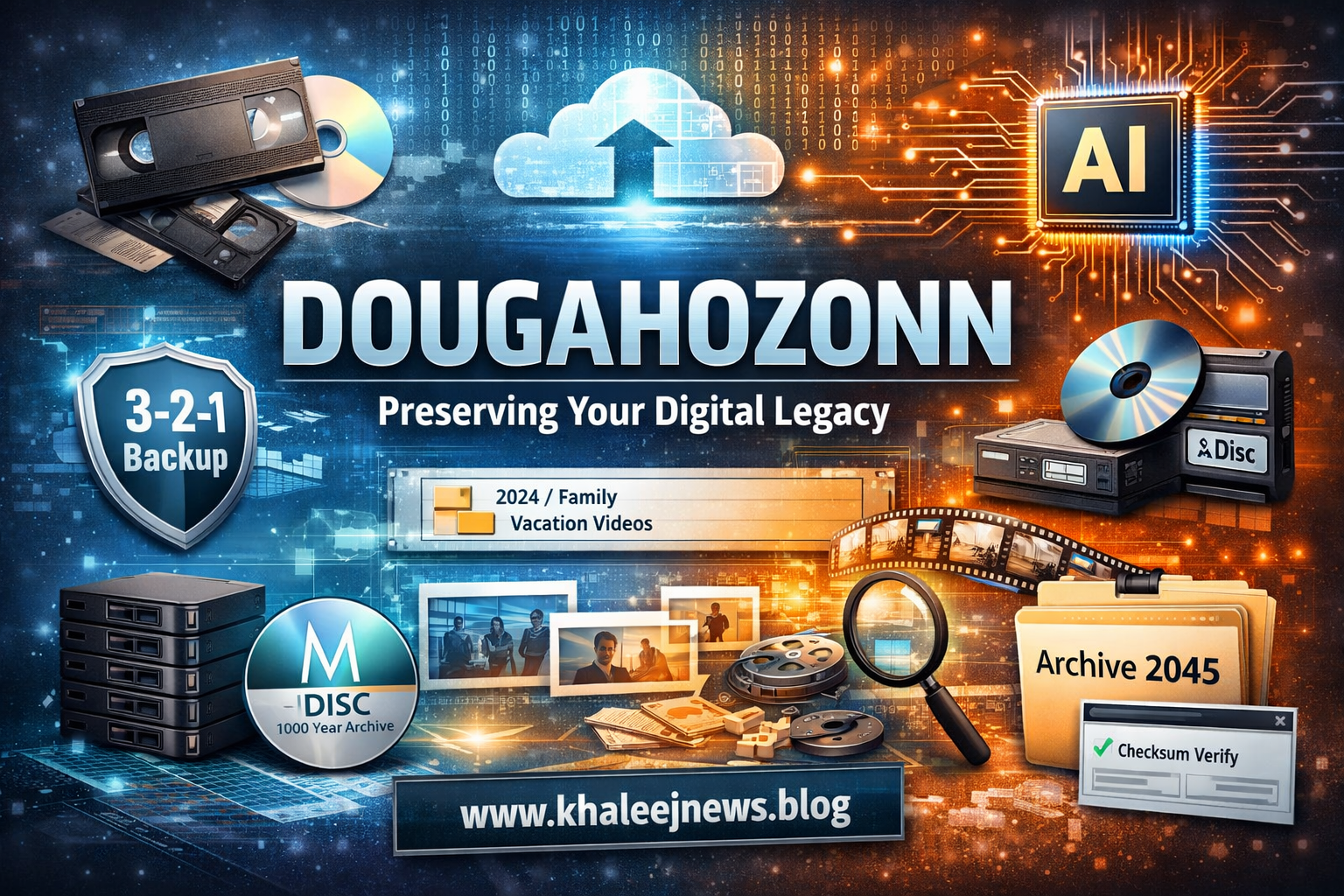
The gold standard for anyone serious about Dougahozonn is the 3-2-1 backup strategy. This isn’t just for IT professionals; it’s a lifestyle for anyone who values their digital footprint.
- 3 Copies of Data: Keep your original file and at least two backups.
- 2 Different Media Types: Store your backups on different types of hardware (e.g., one on an external drive and one on a NAS or M-Disc).
- 1 Copy Offsite: Keep one backup in a different physical location (Cloud storage or a drive at a friend’s house) to protect against fire or theft.
Tools of the Trade: Hardware and Software
To achieve true Dougahozonn status, you need the right kit. You don’t need to spend thousands, but you do need to be intentional.
High-Endurance Storage
For those archiving video, look for “NAS-grade” hard drives. These are designed to stay on 24/7 and have better vibration resistance. Brands like Western Digital (Red Pro) or Seagate (IronWolf) are the industry standards for a reason.
Cold Storage Solutions
If you want to “set it and forget it,” consider LTO (Linear Tape-Open) or M-Discs. M-Discs are specialized DVDs/Blu-rays that use a rock-like recording layer instead of organic dye, theoretically lasting up to 1,000 years. This is the pinnacle of the Dougahozonn philosophy for personal use.
Software Checksums
Use tools like Teracopy (Windows) or Carbon Copy Cloner (Mac). These programs verify that the file copied to the destination is a bit-for-bit match of the original. If a single 1 or 0 is out of place, the software alerts you.
The Role of AI in Video Preservation
As we move further into the 2020s, Artificial Intelligence is playing a massive role in how we maintain our digital archives. AI upscaling can take old, low-resolution footage and enhance it to 4K, making it watchable on modern displays.
Furthermore, AI-driven metadata tagging allows you to search your Dougahozonn archives for specific faces, objects, or locations without having to manually label thousands of hours of footage. This makes an archive a “living” resource rather than a digital graveyard.
Organizing Your Archive for Success
A drive full of files named “MOV_001.mp4” is useless. Organization is the silent partner of preservation.
- Standardized Naming Conventions: Use
YYYY-MM-DD_Event_Location. This ensures files remain in chronological order regardless of the operating system. - Folder Hierarchy: Don’t go too deep. A shallow folder structure (Year > Category > Project) is easier to navigate and less prone to path-length errors in Windows.
- Sidecar Files: Keep text files or “ReadMe” files within your folders explaining what the footage is. You might know who “Grandma” is, but will your great-grandchildren?
Common Mistakes to Avoid
Even with the best intentions, many fall into traps that compromise their Dougahozonn efforts:
- Relying Solely on Social Media: Never use Facebook or Instagram as your “backup.” They compress your videos heavily, stripping away quality, and if your account is banned or the platform closes, your memories go with it.
- Neglecting the “Check-up”: At least once a year, plug in your backup drives. Spin them up, check the health of the disks, and ensure the files still open.
- Using Cheap Flash Drives: USB thumb drives are for temporary transport, not long-term storage. They are highly prone to failure and data loss.
The Ethical Side of Digital Archiving
In a world of constant surveillance and data harvesting, Dougahozonn also touches on digital sovereignty. By owning your storage and your backups, you reclaim your data from big tech corporations. You decide who sees it, how it’s used, and how long it exists. In a sense, digital preservation is an act of privacy and independence.
Conclusion
Building a robust Dougahozonn system is a marathon, not a sprint. It starts with a single step: backing up that one folder of irreplaceable videos you’ve been meaning to protect. As technology evolves, our methods will change, but the goal remains the same—ensuring that our stories, our art, and our memories survive the test of time.
Digital files are fragile, but with the right strategy, they can be more permanent than paper. Start your preservation journey today, and give your future self the gift of a clear, accessible past.